
Every infrastructure layer that matters started with a small group of organizations willing to adopt it before it was obvious. DNS, TLS, OAuth -- none of them scaled because everyone agreed at once. They scaled because a few committed early, and the rest followed when the cost of not participating became clear.
MIR is at that moment now.
What MIR Does
MIR is participation history infrastructure. It sits between platforms -- not inside them.
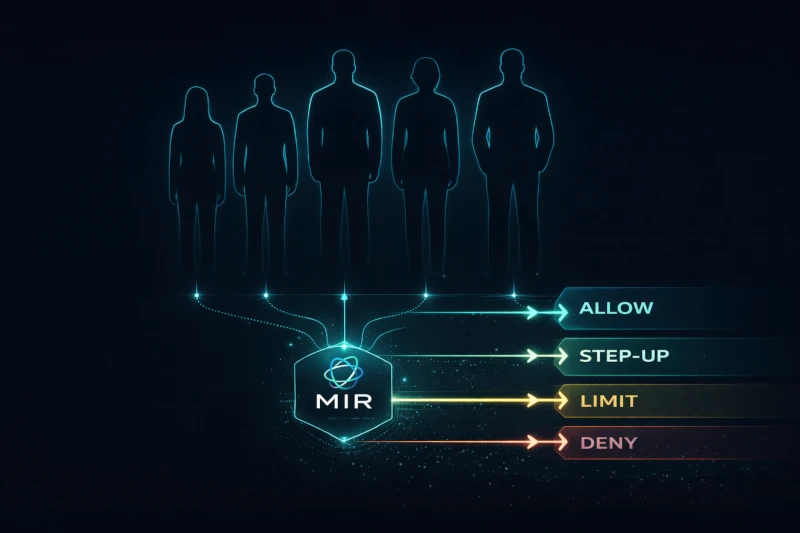
Partners submit behavioral events through the API. MIR records them as participation history: hashed, portable, and neutral. When a platform needs to make a trust decision about a user, it queries MIR and gets back a signal based on that user's cross-platform history.
Four signals. Nothing ambiguous:
- ALLOW -- established participation history supports this action
- STEP_UP -- limited history; request additional verification
- LIMIT -- insufficient history for this action at this volume
- DENY -- history patterns indicate this action should be blocked
MIR doesn't score users. It doesn't judge behavior. It provides evidence -- platforms decide what it means.
Why This Can't Wait
Every platform today makes trust decisions with incomplete information. Your fraud team sees what happens inside your system. Your risk engine models behavior within your boundaries. Your identity provider confirms authentication.
None of them can answer the simplest cross-platform question:
Has this account participated anywhere else, ever?
That's not a feature gap. That's a structural blind spot. And it's the exact gap that coordinated abuse, extraction attacks, and synthetic identities exploit.
A single platform sees "normal user making normal requests." MIR sees the same identity querying 7 platforms with 34,000 requests in 2 hours -- a pattern no individual platform can detect alone.
The Founding Partner Program
We're selecting 5 founding enterprise partners for one-year contracts at founding pricing.
This is not a pilot. This is not a free trial. Founding partners commit, and MIR commits back.
What Founding Partners Get
Who This Is For
MIR is built for platforms where users transact, interact, or authenticate across system boundaries. If your users also exist on other platforms -- and you're making trust decisions without knowing what happened there -- this is your problem.
Good fits:
- Marketplaces -- where buyers and sellers carry reputation that doesn't transfer
- AI platforms and model providers -- where usage patterns span multiple services and extraction attacks cross system boundaries
- Fintech and payment platforms -- where synthetic identities exploit the gap between authentication and history
- SaaS platforms with user-generated content -- where new accounts behave differently than established ones
- Enterprise systems with partner or contractor access -- where external identities need continuity signals without surveillance
What MIR Is Not
MIR doesn't compete with your existing stack. It gives your existing stack something it's never had.
- Not a fraud detection system -- it provides the cross-platform evidence your fraud system is missing
- Not an identity provider -- it adds behavioral continuity on top of authentication
- Not a risk engine -- it supplies the signals your risk engine can't generate from internal data alone
- Not a surveillance tool -- all identifiers are SHA-256 hashed, no plaintext personal data is stored
MIR is infrastructure. It's the layer between platforms that makes cross-system trust decisions possible for the first time.
Why Neutral Matters
This kind of infrastructure can't be built by a platform that competes with its own participants. If Google builds it, AWS won't participate. If AWS builds it, Azure won't contribute. If any of them build it, independent platforms won't trust the data.
MIR works because it's neutral. It doesn't sell ads, run a marketplace, or offer competing services. It records participation history. That's it.
Neutrality isn't a marketing position. It's an architectural requirement.
5 Spots. First Come, First Committed.
Founding pricing locks for year one. Standard enterprise pricing starts at $25,000/year.
If cross-platform behavioral visibility is a problem you're already trying to solve with internal data alone -- stop. This is the missing layer.
Submit an Enterprise Inquiry →
Or DM me directly on LinkedIn
MIR -- Memory Infrastructure Registry
Participation history. Nothing more. Nothing less.