
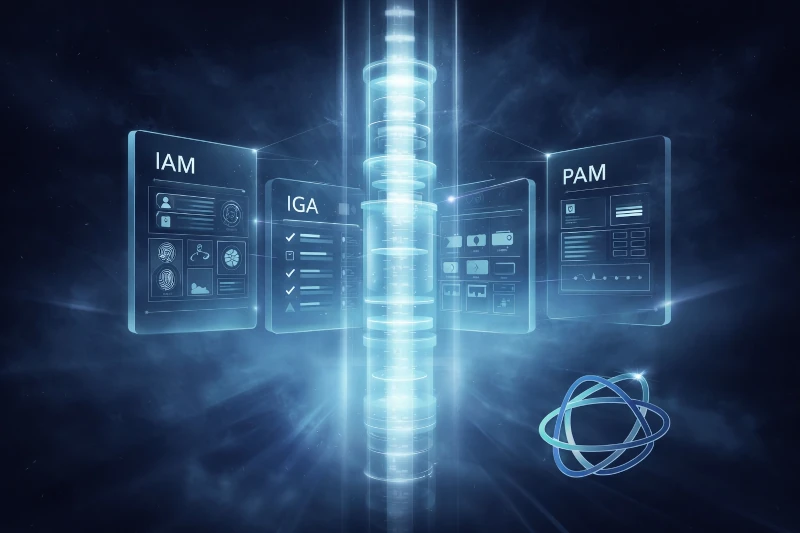
IAM tells you who someone is. IGA tells you what they should have access to. PAM tells you which keys to lock up.
None of them give you the behavioral signal to make that decision yourself.
Identity infrastructure has spent two decades answering the wrong question. We've built increasingly sophisticated systems to verify that a person is who they claim to be — and then we hand them the keys based on a role someone assigned in a spreadsheet six months ago.
Think about what happens after authentication. A user passes MFA, clears device trust, satisfies conditional access policies. They're "in." Now what?
But nobody asks: based on everything this person has done across every platform they interact with, what does the behavioral signal say about this action right now?
That's the gap. And it's massive.
A contractor passes your SSO check. Their credentials are valid. Their device is enrolled. IAM gives them the green light. But across three other platforms, they've had chargebacks reversed, disputes filed against them, and an account suspended. You'd never know. IAM doesn't look there. It can't.
An employee requests elevated access. IGA confirms the request follows policy. PAM records the session. But this person has been flagged for velocity anomalies on two partner systems and failed device fingerprint checks on a third. Your governance tooling is blind to it because it only sees what happens inside your walls.
The Behavioral Signal Layer
MIR is the behavioral signal layer that IAM, IGA, and PAM don't have.
MIR doesn't replace your identity stack — it makes it smarter. Partners submit behavioral events (transactions completed, accounts verified, disputes filed, policy violations) through a shared infrastructure, and MIR provides portable reputation signals across multiple trust dimensions.
When a user authenticates, MIR can tell you:
- This person has 200+ verified transactions across 4 platforms over 90 days — high trust.
- This person was created yesterday, has one event, and just triggered a velocity burst — proceed with caution.
- This person has an active chargeback dispute on another platform right now — step-up auth recommended.
This isn't a credit score. It's a real-time, multi-dimensional trust signal built from actual behavioral data across the systems where people do business.
Trust Is a Gradient
The industry talks about Zero Trust like it's a binary. You either trust or you don't. But trust isn't binary — it's a gradient, and it changes with every interaction.
One is a gate. The other is intelligence.
Your identity stack is incomplete. Not because it's broken — because it was never designed to carry behavioral signal across organizational boundaries.
MIR is the missing layer.