
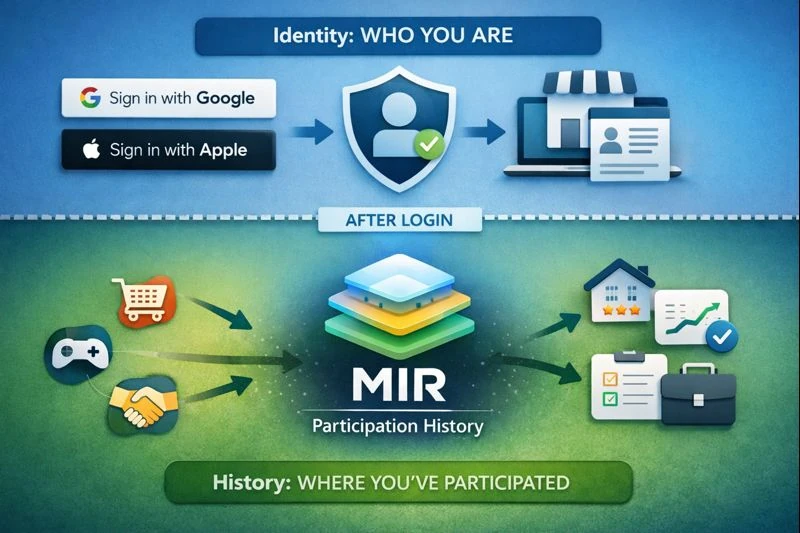
Buttons like Sign in with Google and Sign in with Apple are now standard across the internet. Because MIR also connects accounts across platforms, it's reasonable to ask whether MIR is just another form of login.
It isn't.
The difference isn't subtle — these systems operate at completely different layers of the stack and answer different questions.
What Google and Apple Sign-In Actually Do
Sign in with Google and Sign in with Apple are OAuth-based identity services provided by Google and Apple.
Their role is narrow and well-defined:
They confirm that a user is the same person across login sessions.
How social login works
- A user selects Google or Apple at login
- The identity provider verifies the account
- The platform receives a stable identifier
- The platform creates or accesses a local account
What this solves
- Session continuity
- Account recovery
- Reduced password handling
What this does not solve
- Whether the user has participated elsewhere
- Whether they are new or returning in a broader sense
- Whether any prior activity exists outside the platform
Social login establishes identity continuity, not history continuity.
The Gap: What Happens After Login
Once authenticated, platforms still operate in isolation.
A user with years of activity elsewhere appears identical to a first-time participant. Each platform must independently observe behavior from zero, even when relevant participation has already occurred.
This isn't a failure of login systems — it's simply not what they're designed to do.
What MIR Actually Is
MIR is not:
- a login system
- an identity provider
- a scoring engine
MIR is a participation history layer.
Its purpose is to answer a different question:
"Does this account have recorded participation history across linked platforms?"
How MIR works
- A user creates a MIR account
- The user explicitly links platforms they already use
- Platforms submit event-based records (e.g. completed actions)
- Platforms may query MIR for aggregated, non-identifying signals
Example response
{
  "historyTier": "established",
  "totalEvents": 47,
  "partnerCount": 3
}
No cross-platform identifiers are shared.
No personal data is exchanged.
No inferences are made.
How MIR Is Structurally Different
MIR does not authenticate users
- Login occurs entirely outside of MIR
- MIR assumes the user is already authenticated
- MIR never grants or denies access
MIR does not profile
- No traits are inferred
- No predictions are generated
- No behavior is extrapolated
MIR does not score
- No numeric values
- No rankings
- No comparative judgments
MIR exposes continuity, not conclusions
- Signals reflect recorded events
- Outcomes follow documented partner policies
- Logic is explainable and auditable
Side-by-Side Comparison
| Aspect | Google / Apple Sign-In | MIR |
|---|---|---|
| Layer | Authentication | Participation history |
| Primary question | "Is this the same user?" | "Does history exist?" |
| Scope | Single platform | Cross-platform |
| Data shared | Identity identifiers | Aggregated event counts |
| Inference | None | None |
| User control | Login consent | Explicit linking & unlinking |
| Portability | No | Yes |
The Core Distinction
Google and Apple establish identity continuity.
MIR establishes participation continuity.
They are complementary, not competitive.
MIR is designed to operate after login — regardless of how authentication is handled — and provide neutral historical context without introducing profiling, scoring, or opaque decision-making.
Why This Layer Exists
When participation history is locked inside individual platforms:
- Every account begins as "unknown"
- Context resets everywhere
- Platforms compensate with friction or manual review
MIR enables:
- Continuity without identity sharing
- Context without inference
- History without judgment
Not by replacing login — but by making participation portable.