
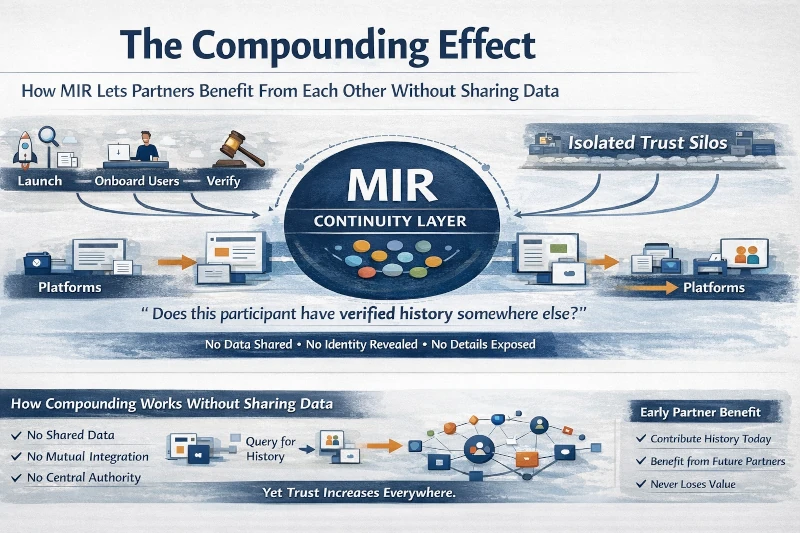
Most platforms treat trust as something you must build alone.
You launch. You onboard users. You verify activity. You moderate behavior. You accumulate history.
Then—no matter how well you do it—that history stays trapped inside your system.
The next platform repeats the same work from scratch.
Neutral systems rarely gain traction on the internet. Not because they don't work—but because they refuse to rank, enforce, or extract leverage.
MIR was designed with that constraint intentionally.
MIR exists to break the cycle of isolated trust.
Not by sharing users. Not by pooling data. Not by creating a network or marketplace.
But by allowing participation history to compound across platforms—quietly, indirectly, and without coordination.
The problem with isolated trust
Every platform already emits signals of trust:
- Completed transactions
- Fulfilled orders
- Successful collaborations
- Verified participation
These signals are real. They're earned. They're costly to fake.
But today, they are isolated.
When a participant moves elsewhere, all of that context disappears. Platforms don't mistrust users because users are untrustworthy. They mistrust them because history doesn't travel.
MIR's role: continuity, not exchange
MIR does not move data between platforms.
Instead, it provides a neutral continuity layer that answers a single question:
Does this participant have verified history somewhere else?
That's it.
- No identity revealed
- No source disclosed
- No event details exposed
- No judgment applied
Platforms remain sovereign. Users remain in control. MIR simply confirms that history exists.
How compounding works (without sharing anything)
When a partner emits verified events into MIR, they contribute to a growing pool of participation history that:
- Is not visible to other partners
- Is not queryable in detail
- Is not transferable or exportable
Yet still creates value.
Later, when another partner queries MIR—with the user's consent—they may learn that the participant is not starting from zero.
That signal exists only because someone else previously verified real activity.
No data was shared. No agreement was signed. No coordination occurred.
This works because MIR remains neutral. The moment it shares sources, exposes details, or applies judgment, compounding breaks.
That is the compounding effect.
Positive externalities, without dependency
Traditional networks grow valuable by locking participants into shared infrastructure.
MIR grows valuable by doing the opposite.
- Partners do not depend on each other
- Partners do not integrate with each other
- Partners do not even know who else is participating
Yet each new partner increases the likelihood that a future participant arrives with existing history.
This creates positive externalities without creating a network, marketplace, or gatekeeper.
Why early partners aren't penalized
In most ecosystems, early adopters take on risk without immediate upside.
MIR avoids that trap.
An early partner:
- Emits verified history today
- Benefits immediately from any later partner activity
- Never loses value as the ecosystem grows
History compounds forward and backward in time.
There is no late advantage. There is no preferred access. There is no exclusive tier.
What this is not
To be clear, MIR is not:
- A reputation score
- A trust marketplace
- A data exchange
- A user directory
- A ranking system
Partners do not share users. They do not pool reputation. They do not gain insight into other platforms' activity.
They gain context, not control.
Why this matters
This model changes how trust infrastructure scales.
Instead of:
Every platform must solve trust alone
We get:
Every platform contributes to a shared continuity layer—without giving anything up
This model does not scale by force, coordination, or control. It scales because every alternative eventually collapses under the cost of rebuilding trust from zero.
Not a network. A non-PII event ledger for verified participation.
Not a gatekeeper. Just continuity—finally built into the internet.